


Disabled Veterans May Also Qualify for Social Security Disability Benefits
Many veterans with disabilities are surprised to learn you can often qualify for VA service-connected disability benefits and Social Security Disability benefits at the same time.
Then they are equally surprised to learn how different the two systems are.
Social Security has two disability programs: Social Security Disability Insurance, which is known as SSDI, and Supplemental Security Income, commonly referred to as SSI.
SSDI pays benefits to you and certain members of your family if you have a disability, and you worked long enough and paid Social Security taxes recently enough. SSI, on the other hand, is based on financial need. The Social Security Administration (SSA) says, “It is designed to help aged, blind, and disabled people, who have little or no income.”
SSDI and veterans’ disability benefits—run by the separate U.S. Department of Veterans Affairs (VA)—are not affected by each other, so you may be eligible to receive both. However, you must apply for them separately. In addition, SSI benefits will be offset by any VA benefits you already receive.
The main difference between Social Security Disability and VA disability is that Social Security Disability does not factor in the degree of severity of disability, and benefit amounts are not paid on a graduated scale. For Social Security, you either fully qualify as having a work-stopping disability, or you don’t.
The VA assigns a percentage disability rating from 0% to 100% in 10% increments.
Disability ratings are the VA’s way of putting a value on how much your disability has decreased your ability to earn a living. But even in the most straightforward cases, the standards that the VA uses to establish disability ratings are complex. And the complexity increases if more than one service-connected disability is involved.
With Social Security Disability, it is all or nothing, meaning that you do not receive more or less depending on the number of medical conditions you have, or how severe they are.
Your medical conditions must prevent you from performing any work you previously did, and from adjusting to other types of work considering your age, education and work experience. Additionally, Social Security requirements stipulate that your disability must have lasted (or is expected to last) 12 months or more or result in death.
For disability benefits under Social Security, a veteran’s disability does not have to be linked to their military service, and they do not consider a veteran’s discharge status.
If you are approved for both SSDI and VA disability, the monthly benefit amounts and eligibility are not affected by the other program. Since SSI is a need-based program with income limits, VA benefits will affect the SSI cash benefit amount. SSA classifies VA benefits as “unearned” income.
It is important to note that because Social Security uses disability standards which are different from the VA’s, they may deny a disability claim even if a veteran is rated at 100% service-connected disability by the VA.
Here’s an overview of the differences between VA disability and SSDI:
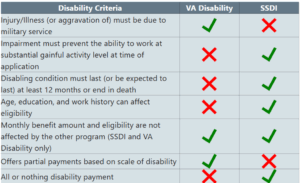
Source: va.gov
For some Wounded Warriors and veterans who have a compensation rating of 100% P&T (permanent and total), Social Security may expedite the processing of their disability claims.
However, the majority of SSDI and SSI cases take many months to be settled, because nearly 70% of Illinois claims are denied on the initial application and claimants must request an appeal hearing.
After waiting six months or more for a decision on an initial application for Social Security Disability benefits, the average wait time for an appeal hearing can also be more than six months.
Some veterans, their spouses, and their dependents may be eligible for other Social Security benefits such as retirement, Medicare, and survivors benefits.
If you are a veteran who has a disabling injury or illness that occurred during your time in service or after you were discharged, the Chicago disability attorneys at Nash Disability Law encourage you to contact our office for a free evaluation of your individual situation.
For VA disability cases, whether you have a new claim or believe you deserve an increase in your disability rating, we can refer you to skilled veterans’ disability lawyers who focus on VA disability law.
If you are eligible for either SSDI or SSI benefits, the disability lawyers at Nash apply our decades of experience to your Social Security Disability claim.
The result is you have a powerful legal team who will fight for your rights. Contact our office for a FREE evaluation of your individual situation, and you only pay a disability lawyer when you win your case.
You served your country. You earned your benefits.